


陽
| ||||||||
සර්ව භාෂාමය
[සංස්කරණය]හන් අනුලක්ෂණය
[සංස්කරණය]陽 (Kangxi radical 170, 阜+9, 12 strokes, cangjie input 弓中日一竹 (NLAMH), four-corner 76227, composition ⿰阝昜)
ව්යුත්පන්න අනුලක්ෂණ
[සංස්කරණය]Related characters
[සංස්කරණය]- 阳 (Simplified form of 陽)
මූලාශ්ර
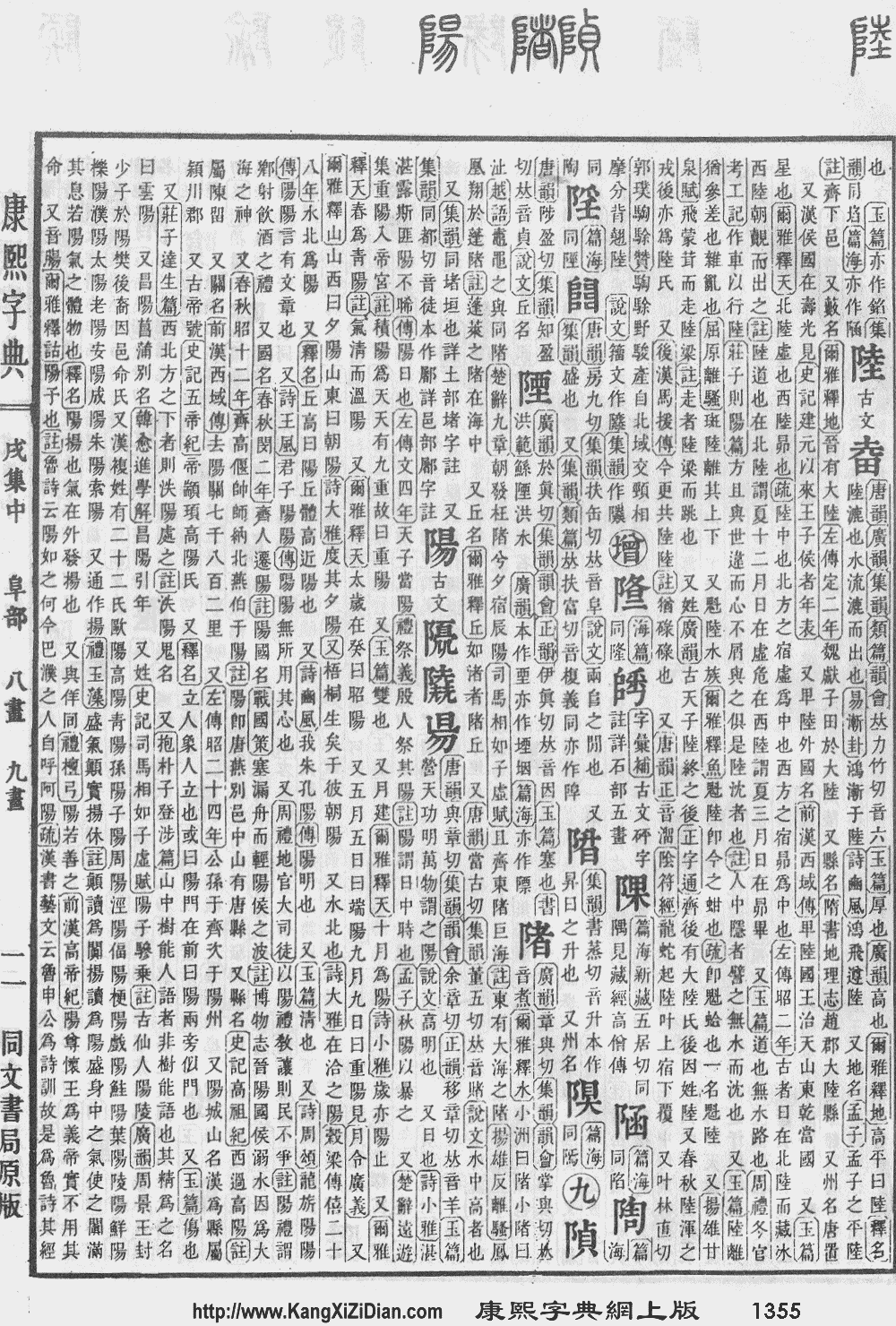
[සංස්කරණය]- Kangxi ශබ්දකෝෂය: පිටුව 1355, අනුලක්ෂණය 15
- Dai Kanwa Jiten: අනුලක්ෂණය 41725
- Dae Jaweon: පිටුව 1859, අනුලක්ෂණය 14
- Hanyu Da Zidian (පළමුවන සංස්කරණය): වෙලුම 6, පිටුව 4144, අනුලක්ෂණය 3
- Unihan data for U+967D
චීන
[සංස්කරණය]| trad. | 陽 | |
|---|---|---|
| simp. | 阳 | |
| alternative forms | ||
(This form in the hanzi box does not have a page created for it yet: "阳".)

Glyph origin
[සංස්කරණය]| Historical forms of the character 陽 |
|---|
| Western Zhou |
| Bronze inscriptions |
 |
Phono-semantic compound (形聲 / 形声) : semantic 阜 (“hill”) + phonetic 昜 (OC *laŋ, “sunshine”). 昜 is the original character for this word, 阜 was added later.
නිරුක්තිය
[සංස්කරණය]Either Sino-Tibetan or a Mainland Southeast Asian (MSEA) Wanderwort; compare බුරුම လင်း (lang:, “bright”), Lepcha ᰣᰦᰜᰩᰵ (a-lóṅ, “reflective light”), තායි ปลั่ง (bplàng, “bright; shiny”) (Schuessler, 2007).
STEDT provisionally sets up Proto-Kuki-Chin *klaaŋ-I, klaan-II (“shine; light; bright”) and compares it to the following:
- 陽 (“sunshine”)
- 景 (OC *kraŋʔ, “bright; scenery”)
- 鏡 (“mirror”)
- 亮 (OC *raŋs, “bright”)
- 章 (“brilliant, splendid; rule; emblem; display (v.)”)
Taken together, the Chinese, Lepcha, Kuki-Chin, and Burmese cognates imply a Proto-Sino-Tibetan *laŋ (“to be bright”).
උච්චාරණය
[සංස්කරණය]- මැන්ඩරීන්
- (Standard)
- (Chengdu, Sichuanese Pinyin): yang2
- (Xi'an, Guanzhong Pinyin): yáng
- (Dungan, Cyrillic and Wiktionary): ён (i͡on, I)
- කැන්ටනීස්
- (Guangzhou–Hong Kong, Jyutping): joeng4
- (Dongguan, Jyutping++): joeng4
- (Taishan, Wiktionary): yiang3
- Gan (Wiktionary): iong4
- Hakka
- Jin (Wiktionary): ion1
- Northern Min (KCR): iô̤ng
- Eastern Min (BUC): iòng
- Puxian Min (Pouseng Ping'ing): ieo2 / iunn2 / yorng2 / yoeng2
- Southern Min
- Wu (Wugniu)
- Xiang (Changsha, Wiktionary): ian2
- Mandarin
- (Standard Chinese)+
- Hanyu Pinyin: yáng
- Zhuyin: ㄧㄤˊ
- Tongyong Pinyin: yáng
- Wade–Giles: yang2
- Yale: yáng
- Gwoyeu Romatzyh: yang
- Palladius: ян (jan)
- Sinological IPA (key): /jɑŋ³⁵/
- (Chengdu)
- Sichuanese Pinyin: yang2
- Scuanxua Ladinxua Xin Wenz: iang
- Sinological IPA (key): /iaŋ²¹/
- (Xi'an)
- Guanzhong Pinyin: yáng
- Sinological IPA (key): /iaŋ²⁴/
- (Dungan)
- Cyrillic and Wiktionary: ён (i͡on, I)
- Sinological IPA (key): /iɑŋ²⁴/
- (Note: Dungan pronunciation is currently experimental and may be inaccurate.)
- (Standard Chinese)+
- කැන්ටනීස්
- (Standard Cantonese, Guangzhou–Hong Kong)
- Jyutping: joeng4
- Yale: yèuhng
- Cantonese Pinyin: joeng4
- Guangdong Romanization: yêng4
- Sinological IPA (key): /jœːŋ²¹/
- (Dongguan, Guancheng)
- Jyutping++: joeng4
- Sinological IPA (key): /zøŋ²¹/
- (Taishanese, Taicheng)
- Wiktionary: yiang3
- Sinological IPA (key): /jiaŋ²²/
- (Standard Cantonese, Guangzhou–Hong Kong)
- Gan
- (Nanchang)
- Wiktionary: iong4
- Sinological IPA (key): /iɔŋ³⁵/
- (Nanchang)
- Hakka
- (Northern Sixian, incl. Miaoli)
- Pha̍k-fa-sṳ: yòng
- Hakka Romanization System: iongˇ
- Hagfa Pinyim: yong2
- Sinological IPA: /i̯oŋ¹¹/
- (Southern Sixian, incl. Neipu)
- Pha̍k-fa-sṳ: yòng
- Hakka Romanization System: (r)iongˇ
- Hagfa Pinyim: yong2
- Sinological IPA: /(j)i̯oŋ¹¹/
- (Hailu, incl. Zhudong)
- Hakka Romanization System: rhong
- Sinological IPA: /ʒoŋ⁵⁵/
- (Meixian)
- (Northern Sixian, incl. Miaoli)
- Jin
- (Taiyuan)+
- Wiktionary: ion1
- Sinological IPA (old-style): /iɒ̃¹¹/
- (Taiyuan)+
- Northern Min
- (Jian'ou)
- Kienning Colloquial Romanized: iô̤ng
- Sinological IPA (key): /iɔŋ³³/
- (Jian'ou)
- Eastern Min
- (Fuzhou)
- Bàng-uâ-cê: iòng
- Sinological IPA (key): /yoŋ⁵³/
- (Fuzhou)
- Puxian Min
- (Putian)
- Pouseng Ping'ing: ieo2
- Báⁿ-uā-ci̍: á̤uⁿ
- Sinological IPA (key): /ieu¹³/
- (Xianyou)
- Pouseng Ping'ing: iunn2
- Sinological IPA (key): /ĩũ²⁴/
- (Putian)
- Pouseng Ping'ing: yorng2
- Báⁿ-uā-ci̍: ió̤ng
- Sinological IPA (key): /yɒŋ¹³/
- (Xianyou)
- Pouseng Ping'ing: yoeng2
- Sinological IPA (key): /yøŋ²⁴/
- (Putian)
- ieo2/iunn2 - vernacular;
- yorng2/yoeng2 - literary.
- Southern Min
- (Hokkien: Quanzhou, General Taiwanese, Xiamen)
- Pe̍h-ōe-jī: iûⁿ
- Tâi-lô: iûnn
- Phofsit Daibuun: viuu
- IPA (Kaohsiung): /iũ²³/
- IPA (Quanzhou, Taipei, Xiamen): /iũ²⁴/
- (Hokkien: Zhangzhou)
- Pe̍h-ōe-jī: iôⁿ
- Tâi-lô: iônn
- Phofsit Daibuun: viooi
- IPA (Zhangzhou): /iɔ̃¹³/
- (Hokkien: Quanzhou, General Taiwanese, Xiamen)
- Pe̍h-ōe-jī: iông
- Tâi-lô: iông
- Phofsit Daibuun: ioong
- IPA (Quanzhou, Taipei, Xiamen): /iɔŋ²⁴/
- IPA (Kaohsiung): /iɔŋ²³/
- (Hokkien: Zhangzhou)
- Pe̍h-ōe-jī: iâng
- Tâi-lô: iâng
- Phofsit Daibuun: iaang
- IPA (Zhangzhou): /iaŋ¹³/
- (Hokkien: Quanzhou, General Taiwanese, Xiamen)
- iûⁿ/iôⁿ - vernacular;
- iông/iâng - literary.
- (Teochew)
- Peng'im: iang5 / iên5 / ion5
- Pe̍h-ōe-jī-like: iâng / iêⁿ / iôⁿ
- Sinological IPA (key): /iaŋ⁵⁵/, /ĩẽ⁵⁵/, /ĩõ⁵⁵/
- (Teochew)
- iên5 - Chaozhou (in placenames);
- ion5 - Shantou (in placenames).
- Wu
- (Northern: Shanghai)
- Wugniu: 6yan
- MiniDict: yan去
- Wiktionary Romanisation (Shanghai): 3hhian
- Sinological IPA (Shanghai): /ɦiã²³/
- (Northern: Jiading, Songjiang, Chongming, Suzhou, Changzhou, Jiaxing, Hangzhou, Fuyang, Shaoxing, Ningbo, Zhoushan)
- Wugniu: 2yan
- MiniDict: yan平
- Sinological IPA (Jiading): /ɦiã³¹/
- Sinological IPA (Songjiang): /ɦiæ̃³¹/
- Sinological IPA (Chongming): /ɦiã²⁴/
- Sinological IPA (Suzhou): /ɦiã²²³/
- Sinological IPA (Changzhou): /ɦiaŋ¹³/
- Sinological IPA (Jiaxing): /ɦiã³¹/
- Sinological IPA (Hangzhou): /ɦiæ̃²³/
- Sinological IPA (Fuyang): /ɦiã¹¹³/
- Sinological IPA (Shaoxing): /ɦiaŋ²³¹/
- Sinological IPA (Ningbo): /ɦiã³¹³/
- Sinological IPA (Zhoushan): /ɦiã²²/
- (Jinhua)
- (Northern: Shanghai)
- Xiang
- (Changsha)
- Wiktionary: ian2
- Sinological IPA (key): /i̯æn¹³/
- (Changsha)
- Middle Chinese: yang
Definitions
[සංස්කරණය]陽
- (philosophy) “male” principle; yang in yin-yang
- sun
- male genitals
- open; overt
- positive
- convex; in relief
- human world; this world
- (Chinese phonetics, of a syllable) closed with a nasal consonantal coda
- south side of mountain or north side of river
- (literary) to feign; to pretend
- පෙළපත් නාමයකි
විරුද්ධ පද
[සංස්කරණය]අමතර අවධානයට
[සංස්කරණය]Compounds
[සංස්කරණය]- 一曲陽關 / 一曲阳关
- 一陽生 / 一阳生
- 三陽 / 三阳
- 三陽交泰 / 三阳交泰
- 上陽宮 / 上阳宫
- 三陽開泰 / 三阳开泰
- 不陰不陽 / 不阴不阳
- 中陽 / 中阳
- 丹陽 / 丹阳
- 亢陽 / 亢阳
- 伯陽 / 伯阳
- 何陽店 / 何阳店
- 信陽 / 信阳
- 偪陽 / 偪阳
- 元陽 / 元阳
- 克里陽
- 六陽會首 / 六阳会首
- 六陽首級 / 六阳首级
- 六陽魁首 / 六阳魁首
- 出太陽 / 出太阳
- 初陽 / 初阳
- 南陽 / 南阳
- 向陽 / 向阳
- 君子陽陽 / 君子阳阳
- 咸陽
- 咸陽宮 / 咸阳宫
- 咸陽火
- 唱陽關 / 唱阳关
- 壯陽 / 壮阳
- 壽陽 / 寿阳
- 壽陽公主 / 寿阳公主
- 壽陽妝 / 寿阳妆
- 夕陽 / 夕阳
- 夕陽工業 / 夕阳工业
- 夕陽簫鼓 / 夕阳箫鼓
- 夕陽餘暉 / 夕阳余晖
- 大小歐陽 / 大小欧阳
- 太陽 / 太阳
- 太陽光譜 / 太阳光谱
- 太陽地 / 太阳地
- 太陽島 / 太阳岛
- 太陽年 / 太阳年
- 太陽旗 / 太阳旗
- 太陽日 / 太阳日
- 太陽時 / 太阳时
- 太陽曆 / 太阳历
- 太陽河 / 太阳河
- 太陽燈 / 太阳灯
- 太陽爐 / 太阳炉
- 太陽病 / 太阳病
- 太陽眼鏡 / 太阳眼镜
- 太陽神 / 太阳神
- 太陽穴 / 太阳穴
- 太陽糕 / 太阳糕
- 太陽系 / 太阳系
- 太陽能 / 太阳能
- 太陽能房 / 太阳能房
- 太陽膏 / 太阳膏
- 太陽自轉 / 太阳自转
- 太陽輻射 / 太阳辐射
- 太陽閃焰 / 太阳闪焰
- 太陽電池 / 太阳电池
- 太陽電波 / 太阳电波
- 太陽風 / 太阳风
- 太陽餅 / 太阳饼
- 太陽鳥 / 太阳鸟
- 太陽麻 / 太阳麻
- 太陽黑子 / 太阳黑子
- 安陽 / 安阳
- 安陽河 / 安阳河
- 官陽 / 官阳
- 小陽春 / 小阳春
- 山陽笛 / 山阳笛
- 岳陽 / 岳阳
- 岳陽樓 / 岳阳楼
- 崇陽 / 崇阳
- 嵩陽書院 / 嵩阳书院
- 平陽 / 平阳
- 平陽公主 / 平阳公主
- 弋陽腔 / 弋阳腔
- 彭陽 / 彭阳 (“Pengyang”)
- 待陽 / 待阳
- 德陽 / 德阳
- 悠陽 / 悠阳
- 悲犬咸陽
- 愆陽 / 愆阳
- 擲果河陽 / 掷果河阳
- 斜陽 / 斜阳
- 日陽 / 日阳
- 昆陽 / 昆阳
- 昭陽 / 昭阳
- 昭陽殿 / 昭阳殿
- 晉陽秋 / 晋阳秋
- 景陽 / 景阳
- 景陽宮井 / 景阳宫井
- 景陽崗 / 景阳岗
- 暮陽 / 暮阳
- 月陽 / 月阳
- 有腳陽春 / 有脚阳春
- 朝陽 / 朝阳
- 朝陽方案 / 朝阳方案
- 朝陽花 / 朝阳花
- 朝陽鳴鳳 / 朝阳鸣凤
- 桂陽 / 桂阳
- 棗陽 / 枣阳
- 樅陽 / 枞阳 (“Zongyang”)
- 歐陽 / 欧阳
- 正陽門 / 正阳门
- 正陽關 / 正阳关
- 歲陽 / 岁阳
- 殘陽 / 残阳
- 沔陽 / 沔阳
- 汾陽 / 汾阳
- 汾陽宮 / 汾阳宫
- 河陽 / 河阳
- 泃陽 / 泃阳
- 泌陽 / 泌阳
- 河陽衰鬢 / 河阳衰鬓
- 洛陽 / 洛阳
- 洛陽才子 / 洛阳才子
- 洛陽橋 / 洛阳桥
- 洛陽紙貴 / 洛阳纸贵
- 海陽 / 海阳
- 渭陽 / 渭阳
- 渭陽之思 / 渭阳之思
- 渭陽之情 / 渭阳之情
- 滎陽 / 荥阳
- 滏陽河 / 滏阳河
- 漢陽 / 汉阳
- 潁陽 / 颍阳
- 漁陽弄 / 渔阳弄
- 漁陽摻撾 / 渔阳掺挝
- 漁陽鞞鼓 / 渔阳鞞鼓
- 潘河陽 / 潘河阳
- 潯陽三隱 / 浔阳三隐
- 瀋陽 / 沈阳
- 火性強陽 / 火性强阳
- 炕陽 / 炕阳
- 炎陽 / 炎阳
- 炎陽炙人 / 炎阳炙人
- 烈陽 / 烈阳
- 燮理陰陽 / 燮理阴阳
- 玉陽 / 玉阳
- 玉陽真君 / 玉阳真君
- 田陽 / 田阳
- 當陽 / 当阳
- 發陽 / 发阳
- 白雪陽春 / 白雪阳春
- 皮裡陽秋 / 皮里阳秋
- 真太陽日 / 真太阳日
- 睢陽 / 睢阳
- 秋陽 / 秋阳
- 端陽 / 端阳
- 端陽競渡 / 端阳竞渡
- 純陽 / 纯阳
- 純陽祖師 / 纯阳祖师
- 紫陽 / 紫阳
- 綿陽 / 绵阳
- 老陽 / 老阳
- 脫陽 / 脱阳
- 臥理淮陽 / 卧理淮阳
- 華陽國志 / 华阳国志
- 萯陽 / 𰰷阳
- 蘭陽平原 / 兰阳平原
- 蘭陽溪 / 兰阳溪
- 衡陽 / 衡阳
- 衡陽雁去 / 衡阳雁去
- 被髮陽狂 / 被发阳狂
- 補陽 / 补阳
- 襄陽 / 襄阳
- 豔陽 / 艳阳
- 豔陽天 / 艳阳天
- 豔陽高照 / 艳阳高照
- 貴陽 / 贵阳
- 資陽 / 资阳 (“Ziyang”)
- 賓陽 / 宾阳
- 遮陽 / 遮阳
- 還陽 / 还阳
- 鄖陽 / 郧阳
- 鄔陽 / 邬阳
- 鄱陽湖 / 鄱阳湖
- 酉陽雜俎 / 酉阳杂俎
- 重陽 / 重阳
- 重陽日 / 重阳日
- 重陽木 / 重阳木
- 重陽節 / 重阳节
- 鎖陽 / 锁阳
- 長陽 / 长阳
- 開陽 / 开阳
- 陰差陽錯 / 阴差阳错
- 陰盛陽衰 / 阴盛阳衰
- 陰虛陽浮 / 阴虚阳浮
- 陰錯陽差 / 阴错阳差
- 陰陽 / 阴阳
- 陰陽不將 / 阴阳不将
- 陰陽五行 / 阴阳五行
- 陰陽交錯 / 阴阳交错
- 陰陽人 / 阴阳人
- 陰陽兩隔 / 阴阳两隔
- 陰陽合曆 / 阴阳合历
- 陰陽和 / 阴阳和
- 陰陽學 / 阴阳学
- 陰陽家 / 阴阳家
- 陰陽對轉 / 阴阳对转
- 陰陽怪氣 / 阴阳怪气
- 陰陽易位 / 阴阳易位
- 陰陽曆 / 阴阳历
- 陰陽水 / 阴阳水
- 陰陽海 / 阴阳海
- 陰陽生 / 阴阳生
- 陰陽祕書 / 阴阳秘书
- 陰陽移 / 阴阳移
- 陰陽臉 / 阴阳脸
- 陰陽間隔 / 阴阳间隔
- 陽世 / 阳世
- 陽中 / 阳中
- 陽九 / 阳九
- 陽九之會 / 阳九之会
- 陽九之阨 / 阳九之阨
- 陽侯 / 阳侯
- 陽侯之患 / 阳侯之患
- 陽傘 / 阳伞
- 陽儒陰釋 / 阳儒阴释
- 陽光 / 阳光
- 陽光普照 / 阳光普照
- 陽光法案 / 阳光法案
- 陽入 / 阳入
- 陽具 / 阳具
- 陽剛 / 阳刚
- 陽去 / 阳去
- 陽和 / 阳和
- 陽報 / 阳报
- 陽塘 / 阳塘
- 陽墳 / 阳坟
- 陽壽 / 阳寿
- 陽奉陰違 / 阳奉阴违
- 陽宅 / 阳宅
- 陽平 / 阳平
- 陽德 / 阳德
- 陽性 / 阳性
- 陽性植物 / 阳性植物
- 陽文 / 阳文
- 陽新 / 阳新
- 陽日 / 阳日
- 陽明 / 阳明
- 陽明先生 / 阳明先生
- 陽明哲學 / 阳明哲学
- 陽明大學 / 阳明大学
- 陽明學派 / 阳明学派
- 陽明山 / 阳明山
- 陽春 / 阳春
- 陽春有腳 / 阳春有脚
- 陽春白雪 / 阳春白雪
- 陽春麵 / 阳春面
- 陽景 / 阳景
- 陽曆 / 阳历
- 陽月 / 阳月
- 陽朔 / 阳朔
- 陽極 / 阳极
- 陽極射線 / 阳极射线
- 陽氣 / 阳气
- 陽江 / 阳江
- 陽湖派 / 阳湖派
- 陽溝 / 阳沟
- 陽烏 / 阳乌
- 陽燧 / 阳燧
- 陽物 / 阳物
- 陽狂 / 阳狂
- 陽狂自免 / 阳狂自免
- 陽珓 / 阳珓
- 陽秋 / 阳秋
- 陽羨 / 阳羡
- 陽聲 / 阳声
- 陽聲韻 / 阳声韵
- 陽臺 / 阳台
- 陽臺春夢 / 阳台春梦
- 陽臺雲雨 / 阳台云雨
- 陽萎 / 阳萎
- 陽虛發熱 / 阳虚发热
- 陽調 / 阳调
- 陽識 / 阳识
- 陽谷 / 阳谷
- 陽起石 / 阳起石
- 陽道 / 阳道
- 陽遂足 / 阳遂足
- 陽邏 / 阳逻
- 陽間 / 阳间
- 陽關 / 阳关
- 陽關三疊 / 阳关三叠
- 陽關大道 / 阳关大道
- 陽關道 / 阳关道
- 陽阿 / 阳阿
- 陽陵虎符 / 阳陵虎符
- 陽陽 / 阳阳
- 陽離子 / 阳离子
- 陽電 / 阳电
- 陽電子 / 阳电子
- 陽面 / 阳面
- 陽韻 / 阳韵
- 陽順陰違 / 阳顺阴违
- 陽鳥 / 阳鸟
- 雙陽 / 双阳
- 雲陽 / 云阳
- 雲陽市 / 云阳市
- 青陽 / 青阳
- 頂陽骨 / 顶阳骨
- 頹陽 / 颓阳
- 顛倒陰陽 / 颠倒阴阳
- 首陽山 / 首阳山
- 驕陽 / 骄阳
- 高陽 / 高阳
- 高陽公子 / 高阳公子
- 高陽狂客 / 高阳狂客
- 高陽酒徒 / 高阳酒徒
- 魯陽揮戈 / 鲁阳挥戈
- 鳳陽花鼓 / 凤阳花鼓
- 鳴鳳朝陽 / 鸣凤朝阳
- 鳳鳴朝陽 / 凤鸣朝阳
- 龍陽 / 龙阳
Descendants
[සංස්කරණය]ජපන්
[සංස්කරණය]කන්ජි
[සංස්කරණය]Readings
[සංස්කරණය]Compounds
[සංස්කරණය]නිරුක්තිය 1
[සංස්කරණය]| මෙම යෙදුම තුළ කන්ජි |
|---|
| 陽 |
| ひ Grade: 3 |
| kun'yomi |
| 陽 යන යෙදුමේ උච්චාරණය සහ අර්ථ දැක්වීම සඳහා – මතු දැක්වෙන ප්රවේශය: 日 |
(මතු දැක්වෙන ප්රවේශය සඳහා පිටුවක් තවම නිර්මාණය කොට නොමැත: 日.)
නිරුක්තිය 2
[සංස්කරණය]| මෙම යෙදුම තුළ කන්ජි |
|---|
| 陽 |
| よう Grade: 3 |
| on'yomi |
From Middle Chinese 陽 (MC yang).
උච්චාරණය
[සංස්කරණය]Affix
[සංස්කරණය]නාම පදය
[සංස්කරණය]නිරුක්තිය 3
[සංස්කරණය]| මෙම යෙදුම තුළ කන්ජි |
|---|
| 陽 |
| あきら Grade: 3 |
| kun'yomi |
උච්චාරණය
[සංස්කරණය]සංඥා නාම පදය
[සංස්කරණය]陽 (Akira)
- unisex පුද්ගල නාමයකි
මූලාශ්ර
[සංස්කරණය]කොරියානු
[සංස්කරණය]නිරුක්තිය
[සංස්කරණය]From Middle Chinese 陽 (MC yang). සැකිල්ල:hanja-hunmong
හන්ජා
[සංස්කරණය]
Wikisource 陽 (eumhun 볕 양 (byeot yang))
- Hanja form? of 양 (“sky; the sun; sun light; morning”).
- Hanja form? of 양 (“male; yang (in contrast to yin)”).
Compounds
[සංස්කරණය]මූලාශ්ර
[සංස්කරණය]වියට්නාම
[සංස්කරණය]හන් අනුලක්ෂණය
[සංස්කරණය]- මෙම පදය සිංහලට පරිවර්තනය කළ යුතුය. කරුණාකර පරිවර්තනයක් ලබා දී,
{{rfdef}}කේතය ඉවත් කරන්න.
Compounds
[සංස්කරණය]- dương lịch (陽曆)
- CJK Unified Ideographs කාණ්ඩය
- හන් අක්ෂරක්රමය තුළ භාවිතා වන අනුලක්ෂණ
- සර්ව භාෂාමය පාඨ
- සර්ව භාෂාමය සංකේත
- සර්ව භාෂාමය සබැඳි, අනු පිටපත් කළ විකි සබැඳි සහිත
- සර්ව භාෂාමය links with redundant alt parameters
- Han phono-semantic compounds
- චීන යෙදුම්, Sino-Tibetan භාෂා වෙතින් ව්යුත්පන්න
- Lepcha terms with non-redundant manual transliterations
- චීන යෙදුම්, Proto-Sino-Tibetan වෙතින් උරුම වූ
- චීන යෙදුම්, Proto-Sino-Tibetan වෙතින් ව්යුත්පන්න
- මැන්ඩරීන් යෙදුම්, ඕඩියෝ උච්චාරණ සහිත
- චීන පාඨ
- මැන්ඩරීන් පාඨ
- Sichuanese පාඨ
- Dungan පාඨ
- කැන්ටනීස් පාඨ
- Taishanese පාඨ
- Gan පාඨ
- Hakka පාඨ
- Jin පාඨ
- Northern Min පාඨ
- Eastern Min පාඨ
- Hokkien පාඨ
- Teochew පාඨ
- Leizhou Min lemmas
- Puxian Min lemmas
- Wu පාඨ
- Xiang පාඨ
- Middle Chinese පාඨ
- Old Chinese පාඨ
- චීන හන්සු
- මැන්ඩරීන් හන්සු
- Sichuanese හන්සු
- Dungan හන්සු
- කැන්ටනීස් හන්සු
- Taishanese හන්සු
- Gan හන්සු
- Hakka හන්සු
- Jin හන්සු
- Northern Min හන්සු
- Eastern Min හන්සු
- Hokkien හන්සු
- Teochew හන්සු
- Leizhou Min හන්සු
- Puxian Min හන්සු
- Wu හන්සු
- Xiang හන්සු
- Middle Chinese හන්සු
- Old Chinese හන්සු
- චීන නාම පද
- මැන්ඩරීන් නාම පද
- Sichuanese නාම පද
- Dungan නාම පද
- කැන්ටනීස් නාම පද
- Taishanese නාම පද
- Gan නාම පද
- Hakka නාම පද
- Jin නාම පද
- Northern Min නාම පද
- Eastern Min නාම පද
- Hokkien නාම පද
- Teochew නාම පද
- Leizhou Min nouns
- Puxian Min nouns
- Wu නාම පද
- Xiang නාම පද
- Middle Chinese නාම පද
- Old Chinese නාම පද
- චීන නාම විශේෂණ පද
- මැන්ඩරීන් නාම විශේෂණ පද
- Sichuanese නාම විශේෂණ පද
- Dungan නාම විශේෂණ පද
- කැන්ටනීස් නාම විශේෂණ පද
- Taishanese නාම විශේෂණ පද
- Gan නාම විශේෂණ පද
- Hakka නාම විශේෂණ පද
- Jin නාම විශේෂණ පද
- Northern Min නාම විශේෂණ පද
- Eastern Min නාම විශේෂණ පද
- Hokkien නාම විශේෂණ පද
- Teochew නාම විශේෂණ පද
- Leizhou Min adjectives
- Puxian Min adjectives
- Wu නාම විශේෂණ පද
- Xiang නාම විශේෂණ පද
- Middle Chinese නාම විශේෂණ පද
- Old Chinese නාම විශේෂණ පද
- චීන යෙදුම්, ස්වරශාස්ත්ර හෝඩි උච්චාරණ සහිත
- චීන යෙදුම්, 陽 භාවිතා කොට ලියන ලද
- zh:Philosophy
- zh:Sun
- මැන්ඩරීන් යෙදුම්, භාවිත නිදර්ශන සහිත
- zh:Genitalia
- zh:COVID-19
- චීන neologisms
- zh:Phonetics
- චීන literary terms
- චීන surnames
- Advanced Mandarin
- ජපන් කන්ජි
- ජපන් third grade kanji
- ජපන් kyōiku kanji
- ජපන් ජෝයෝ කන්ජි
- ජපන් kanji with goon reading よう
- ජපන් kanji with historical goon reading やう
- ජපන් kanji with kan'on reading よう
- ජපන් kanji with historical kan'on reading やう
- ජපන් kanji with tōon reading やん
- ජපන් kanji with kun reading ひ
- ජපන් kanji with nanori reading あき
- ජපන් kanji with nanori reading あきら
- ජපන් kanji with nanori reading みなみ
- ජපන් kanji with nanori reading あけ
- ජපන් kanji with nanori reading はる
- ජපන් kanji with nanori reading ひろ
- ජපන් kanji with nanori reading やん
- ජපන් kanji with nanori reading よ
- ජපන් යෙදුම්, 陽 භාවිතා කොට ලියා ひ ලෙස කියවන
- ජපන් terms read with kun'yomi
- ජපන් යෙදුම්, 陽 භාවිතා කොට ලියා よう ලෙස කියවන
- ජපන් terms read with on'yomi
- ජපන් යෙදුම්, Middle Chinese වෙතින් ව්යුත්පන්න
- ජපන් යෙදුම්, ස්වරශාස්ත්ර හෝඩි උච්චාරණ සහිත
- ජපන් පාඨ
- ජපන් affixes
- ජපන් terms with multiple readings
- ජපන් යෙදුම්, third grade kanji භාවිතා කොට ලියන ලද
- ජපන් terms with 1 kanji
- ජපන් යෙදුම්, 陽 භාවිතා කොට ලියන ලද
- ජපන් single-kanji terms
- ජපන් නාම පද
- ජපන් යෙදුම්, භාවිත නිදර්ශන සහිත
- ජපන් යෙදුම්, 陽 භාවිතා කොට ලියා あきら ලෙස කියවන
- ජපන් සංඥා නාම පද
- ජපන් පුද්ගල නාම
- ජපන් පුරුෂ ලිංග පුද්ගල නාම
- ජපන් ස්ත්රී ලිංග පුද්ගල නාම
- ජපන් unisex given names
- කොරියානු යෙදුම්, Middle Chinese වෙතින් ව්යුත්පන්න
- කොරියානු හන්ජා
- වියට්නාම පාඨ
- වියට්නාම හන් අනුලක්ෂණ
- Requests for definitions in වියට්නාම entries
- වියට්නාම යෙදුම්, අනු පිටපත් කළ සෝට්කී සහිත